

“Perhatian….! Dilarang kencing dilantai. Harap kencing dikloset. Trims.”
“Attention! It is forbidden to pee on the floor. Please use the toilet. Thanks.”
– Sign on the door of a hotel bathroom, Kendari, Southeast Sulawesi
We are the least trained for the Most Important Acts of our lives: Being born. Selecting a mate. Traveling to foreign lands. Dying.
Or dying to go to the bathroom in a foreign land; perhaps the most ubiquitous of the Most Important Acts for intrepid travelers. As most intrepid travelers know, we tend to spend a gazillion hours with other intrepid, inebriated travelers discussing All Things Scatalogical, because although the contents of these distressingly detailed conversations do not bear repeating, or even remembering, somehow the recounting of the crudest human acts binds us one to another, much as a stray piece of toilet tissue gloms onto the base of one’s shoe and flutters behind, quietly bearing witness.
As a scientist trained in a diverse set of field methodologies, I posit that if we were better versed in certain rudimentary survival skills, including, but not limited to How to Shit in the Woods[1], our stories would be quite different. Alack and alas, we [sub]urbane citizens of the 21st century remain determinedly untrained and delicately squeamish, creating ideal fodder for the so-called-but-nevertruly “reality” shows that litter today’s digital media.
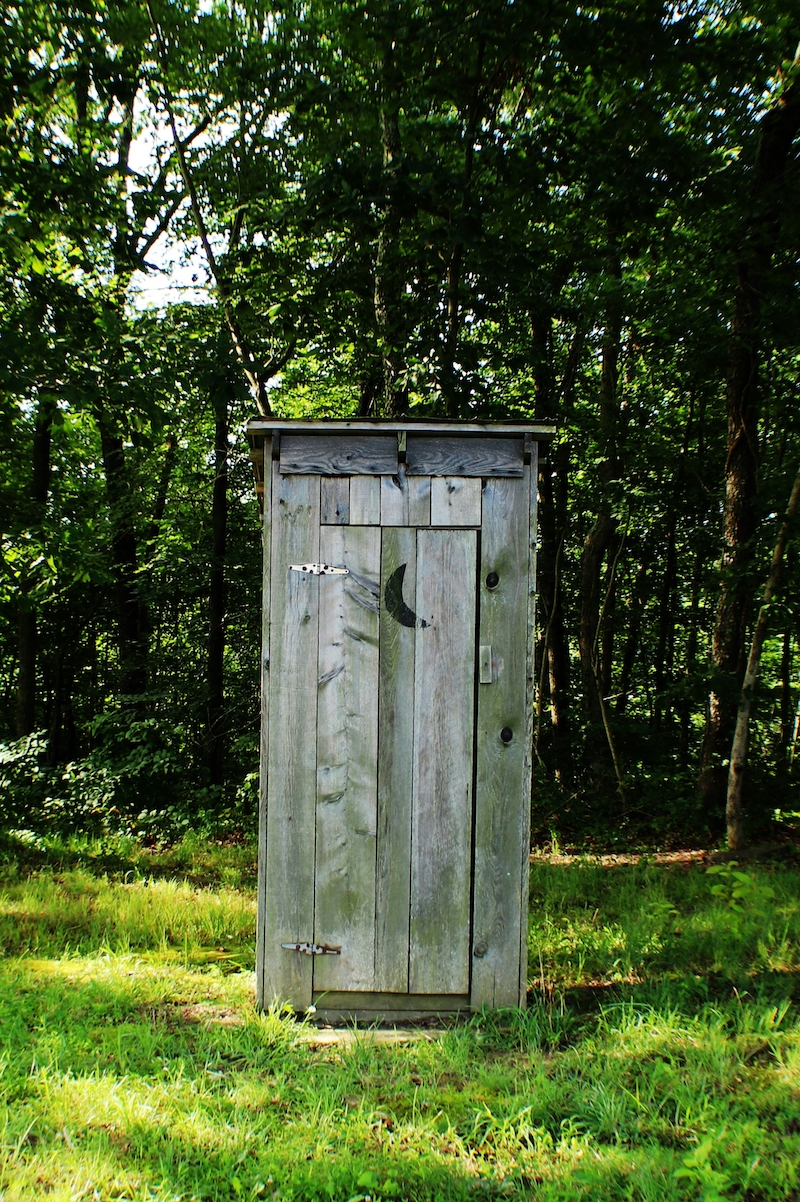
In the fifteen points below, I unapologetically – yet humbly – offer an ethnoecological dissertation on conquering the omnipresent pit latrine, a bathroom equivalent serving the vast majority of today’s hominids.
My overview of how to conduct oneself during this Most Important Act, an interdisciplinary treatment that encompasses the natural, physical, and socio-cultural aspects, may possibly be the most extensive – yet concise – treatise on this subject available in written form.
- Site Location. Flush toilets (those things with seats, lids, a water tank, and a handle) are largely absent from exotic rural landscapes. Forget flush toilets. Banish these luxurious images from your mind. If you are lucky, the village will possess a least one latrine, which may – or may not – have within it a structure resembling what you think of as a “toilet.” The designated location can be reached by going under the mango tree, over the stone fence, around the pig slough and through the mud to the bamboo enclosure that is not (a) the bathing area, or (b) the chicken coop. If you are not lucky and no latrine exists within several kilometers, pay close attention to the surrounding topography and vegetation, and plan ahead. Only certain habitats will serve one’s purposes, preferably those dominated by dense and/or broad-leafed foliage. The typical tropical tree, while lovely to gaze upon, with its tall, smooth, trunk and branches twenty feet above your head, is not your friend. Ditches, scrubby bushes, clumps of bamboo, and clusters of cacti will be your next best option, especially if these natural enclosures block at least two lines of sight from potential observers. If there are no natural enclosures within striking range, your hostess may offer you a woven cloth, a.k.a. your portable pee/poop stall. Your hostess may graciously offer to stand nearby, holding a dipper full of water and a cloth rag, and to act as a lookout, to help you avoid perpetual fame as the visitor who inadvertently mooned a respected village elder. Rid yourself of foolish pride. Acceptance of this offer is highly recommended: she will be discrete.
- Psychosomatic Preparation. Rustic pit latrines, while an elemental necessity, are an exercise in gymnastics and self-control. Yes, these smelly, stinky holes in the ground are the yuckiest, most horridly vile places you have ever, or will ever, experience in your entire existence. They are far, far worse than any campground composting toilet or yet-to-be-cleaned roadside Port-A-Potty. The stench can be overwhelming, the visuals terrifying. Gird your loins, breathe through your mouth, and push forth with cheerful determination. Avoid panicking, screaming, or loud obscenities, as half the village is now keenly aware that you just stepped out of the meeting to undertake #1 or #2, or possibly both. At this moment they are debating your options, along with a minute discourse on the health of your gastro-intestinal system, wondering if it was the mangos. Or possibly the chilies you insisted on adding to your meal to prove your cultural hipness (refer to Section 13 below on “Special Circumstances”). Do not lose sight of the fact that you are under careful public scrutiny during these most challenging, yet intimate moments of your life. Above all, keep breathing. This is the last place you want to pass out.
- Holistic Checklist. Entering latrines without prior logistical, physical, and mental preparation is, quite literally, a crap shoot. In rural Asia (or Africa, or the Americas or Australia or the Pacific Islands or the Poles), that which we call “toilet paper,” n’est existe pas – it does not exist, so bring your own, or go without. No lights, either. Thus between sunset and sunrise, some form of a torch: a flashlight, candle, kerosene lamp, or one of those traditional handmade jobs crafted from a palm rib and kapok fibers rolled in crushed Aleurites moluccana candlenuts, assuming one keeps all live flames at least ten centimeters from the bamboo thatch walls, door, and ceiling, and of course one’s clothing, is absolutely essential. A sympathetic friend standing nearby, providing moral support and guardianship, is also a vital resource. During diurnal or nocturnal excursions, when approaching the latrine, village protocol requires a loud yodel of “whoooo!” while still several meters away to avoid surprising a family member, neighbor, or fellow guest. Pause, wait at least three moments for an answer. Remember that certain types of clothing enable a less stressful experience when engaging in one’s business: voluminous skirts are preferable to pants; and loose, elasticized trousers work much better than tight, form-fitting jeans or anything with pesky zippers and metal buttons. Positioning and timing, along with a keen attentiveness to detail, are sine que non within the confines of the latrine; see Sections 5-8, below.
- Site Inspection. During your initial peek-in, locate the water bucket, or anything that holds water. Find another one if someone walked off with the last container. Ensure the bucket contains at least one liter of water and some type of functioning scoop, i.e., half a coconut shell or the cut-off base of a plastic bottle, because simply using one’s left hand – only and always the left! – to withdraw water, although culturally appropriate, is both unhygienic and inefficient. Once settled in the latrine, secure the perimeter, including the door latch, if there is one (see Section 6, below). Control your breathing: continuing to inhale through one’s mouth counteracts the intense odor.
- Biology: Perform a biodiversity inventory, with particular attention to invertebrates. Certain members of the insect orders Arachnida (spiders, scorpions, centipedes, mites, ticks), Blattaria (cockroaches), Ephemeroptera (mosquitoes), Coleoptera (beetles), Diptera (houseflies), Homoptera (nasty flies that bite), Hymenoptera (bees, wasps, ants), Isoptera (termites), Lepidoptera (butterflies, moths), Odonata (dragonflies), and Orthoptera (grasshoppers and crickets) are tolerable, others most certainly are not! Parasitic worms of the Trematode, Nematode, and Cestode phlya abound, but are usually invisible to the naked eye (or other naked bits). The population density and distribution of these organisms will determine how you position certain, more sensitive, body parts. The large, red-spotted, powder-blue-skinned Tokay gecko is your friend: s/he dines largely on the above-mentioned species. Try not to run yelling out of the latrine when the gecko makes a sudden lurch. Just keep your fingers away: when geckos bite, they clamp down hard. As for other vertebrates: resident chickens, ducks, geese, goats, sheep, hogs, dogs, cats, cattle, horses, mules, water buffalo, and/or village children roaming immediately outside the latrine generally do not pose a threat, as they usually will not enter the latrine. (Baby and juvenile chicks tend to be the exception.)
- Infrastructure. The bamboo (or wooden or corrugated metal) door of the latrine must be firmly and completely shut, even if you have to drag, heft, lurch, slam, and kick it firmly into place before employing the latch or doorstop (if there is one). If the latrine doorway is covered with a threadbare cloth instead, secure the cloth using every available bent nail on either side of the doorway, as a cloth flapping back and forth with the wind can prove unnerving and indiscriminately revealing. Examine the bamboo slats in the walls for gaps that are more than 4 millimeters wide, and angle your stance accordingly. Ditto for similarly sized gaps in the ceiling, especially if it is raining, or the day is exceptionally windy, or both.
- Physics. To properly execute a squat, strong upper thigh muscles, a good sense of balance, and practiced aim are essential. Check the angle and slope of the sluice leading to the pit, as this will determine placement of one’s posterior and orifices. Depending on the latrine’s architecture, propping one’s hands against the bamboo slats or concrete walls can be used to steady oneself, but to effectively douche with a coconut shell scoop or plastic dipper, both hands are required. (Remember the left hand is the business hand; see Section 4 above.) If the foot perches on either side of the pit are slick, complex maneuvering is necessary to avoid slippage and potentially dire consequences. Remember that liquids or semi-liquids hitting a hard, curved surface can result in significant, and highly dispersed, splashing. Toes, shoes, skirt hems, pants cuffs, socks, etc. will suffer – possibly for days, depending on when your next opportunity for clothes-washing will occur – if foot placement is not strategically pre-meditated.
- Hydrology. After achieving the proper position, a beginner can move to advanced latrine use by mastering the douche. Doing so while executing a balanced squat is no simple feat, and requires a basic understanding of hydrology and gravity. A scoop of water angled from behind can be trickled more easily into a waiting hand and subsequently transferred to the appropriate locations than a scoop angled from the front, although both approaches are plausible. Forgetting to monitor the available water supply – especially when multiple douching attempts are necessary – is not advised, and can lead to dire circumstances. (Also see Section 12 on water use in the dry season.)
- Loss. Items in one’s back pockets must be removed prior to any significant maneuvers, especially squatting. The pit is sealed within a concrete casing beneath at least a meter of hard-packed soil. The pit was established many, many moons ago, and was never meant to be re-accessed by human hands. Your hosts are gracious, but they have their limits: don’t even think of attempting a recovery.
- Timing. The total number of minutes spent in the latrine should be a function of: (a) the type of business entailed, (b) the total number of people currently present in the household added to the median onsite population of neighboring households and divided by the average age, and (c) the results of the biodiversity survey performed in Section 5. Neophyte users can be expected to reasonably exceed the estimated time by no more than five minutes, except for the special circumstances described in Section 13.
- Meteorology I: The Rainy Season. The floor will be muddy, the foot perches slick. Bamboo or banana trunk perches, due to their angle of curvature, are worse than simple wooden planks, requiring additional dexterity. If there is no ceiling, or if the palm fronds set across the top of the latrine are tattered, or if the tarp only covers a portion of the roof, an open umbrella will suffice, but to hold the umbrella while engaging in one’s business will require even more sophisticated maneuvering skills than the steps detailed in Sections 5-8, and can potentially try one’s patience and resilience. Deep, calming breaths may, or may not help in this situation.
- Meteorology II: The Dry Season. Check the water level in the bucket before initiating any activity. Adhere to the following formula: Potential Water Use (PWE) = ƒ [volume + density]/slope. Use water sparingly, as the pump may have malfunctioned again, a section of upstream pipe could have been kicked apart by a water buffalo, kids might have messed with the faucet, or the rich guy across the street may be siphoning off most of the settlement’s water. Be kind to the next person, and refill the damn bucket if you use the last few millimeters of water.
- Cultural Ecology: Special Situations. Drinking exceptional amounts of palm wine (whether that of the coconut, sugar, or lontar palm) results in constipation, whereas an additional dose of chili sauce in one’s rice bowl or too many fresh mangos consumed as a mid-day snack can engender an opposite effect. Village coffee, resembling diesel fuel in color and potency, can have immediate impact. The uninvited presence of parasitic worms, amoebas, or pathogenic bacteria – all quite common to intrepid travelers and the locales they frequent – in one’s intestinal system can produce a range of effects, most of which are highly undesirable. All special situations merit a doubling, tripling, or even quadrupling of the average time spent visiting the latrine. Additional on-site equipment and supplies may be necessary in these instances. Practicing thighstrengthening exercises prior to field visits helps mitigate these situations, as does learning to sit back on one’s heels for hours at a time like most villagers.
- Exiting. Pull up (or down) whatever needs to be pulled up (or down), and perform a thorough, 360-degree rotational self-check before exiting. Avoid walking out of the latrine with the back of one’s skirt (or sarong) inadvertently stuck in the leg of one’s drawers. The unconscious display of tender skin or telltale splotches on one’s garments can easily become fodder for animated villager discussions for months, even years to come, leading to special pet names or monikers, especially when folks couldn’t pronounce your given name in the first place.
- Gratitude. Pit latrines are a treasure. A rare gift. A private sanctuary. Offer thanks to local deities.
The alternative…? Refer to Section 1.
[1] A slim volume authored by Kathleen Meyer, Ten Speed Press, 1989.
 JEANINE PFEIFFER
Hi Jeanine,Glad to read a story from you.Good to hear you are still writing.My pot-tie story is about replacement of our beloved toilets…Not having to replace one